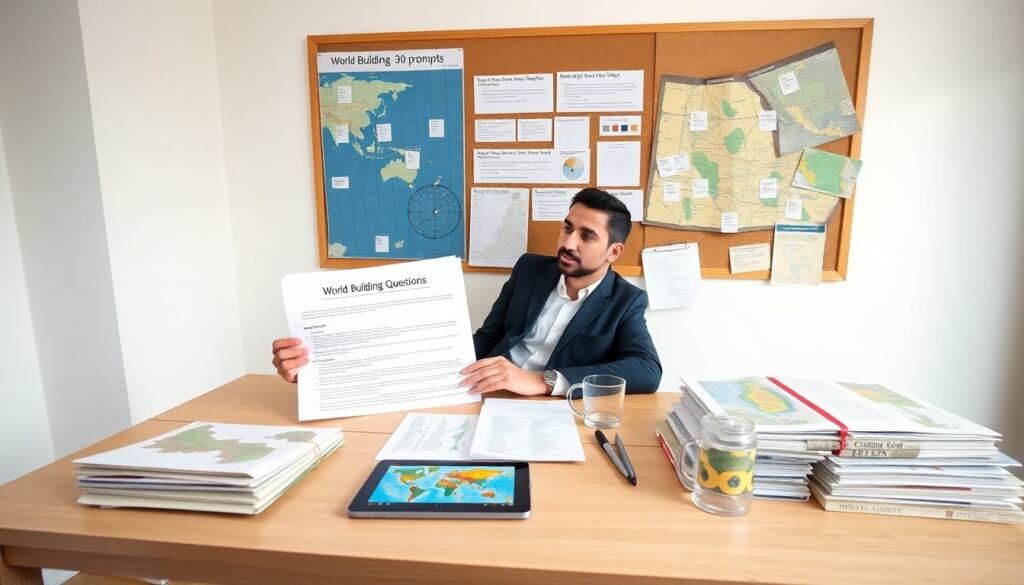
World building questions help writers define setting, conflict, and character habits. The guide lists 30 clear prompts that a writer can use to seed plot and to ground scenes. Each prompt focuses on concrete facts. The prompts aim to make choices fast and repeatable. The reader will use these questions to create coherent rules and to avoid contradictions. Used consistently, world building questions become a reference file that speeds revisions, ensures continuity across chapters, and gives authors a practical way to deepen small moments—what a character carries, how a town smells after rain, or why a minor law matters to a subplot.
Key Takeaways
- World building questions guide writers to define setting, conflict, and character motivations, strengthening plot and reader immersion.
- Answering questions about geography, climate, and natural resources shapes believable conflict and opportunity within the story world.
- Exploring flora, fauna, and ecology helps create detailed environments and plausible daily life for characters.
- Defining social structures, laws, and customs provides depth to society and generates believable social tensions and alliances.
- Clarifying economy, technology, and daily routines makes the world feel lived-in and realistic, supporting plot development.
- Establishing rules and cultural impacts of magic and religion prevents inconsistencies and links supernatural elements to plot and society.
- Keeping a running list of answered world building questions turns individual details into recurring motifs and supports long-form storytelling.
Why World-Building Questions Matter — How They Strengthen Plot, Character, And Reader Immersion
World building questions give a writer guardrails for story decisions. They force the writer to state how the world works. When a writer answers world building questions, plot choices gain stakes. When a writer answers world building questions, character actions gain motive. Readers notice consistent detail. Inconsistent detail breaks immersion. A writer can reuse answers to create recurring rules. A writer can use the same answers to craft obstacles. The result shows up as clearer scenes and stronger pacing.
Beyond consistency, these questions help generate plot hooks: an answered question about a scarce resource suggests trade wars; an answered question about an outlawed practice creates clandestine networks. They also sharpen character—knowing a character’s childhood climate or the legal status of their profession changes how they react in crisis. For writers working at any scale, from short stories to sprawling series, world building questions are practical tools for turning interesting ideas into reliable story mechanics.
Physical World Foundations: Geography, Climate, And Built Environments
Geography and climate define where conflict starts and which resources matter. A writer must list major landforms and prevailing winds. A writer must record key water sources and travel routes. A writer must map population centers and ruin sites. Answering these world building questions lets the story place sieges, migrations, and trade. The physical layout also sets limits for technology and for cultural exchange. Clear geography helps a writer stage action and plan supply lines.
Practically, sketch rough maps and annotate them with answers to core world building questions: who controls the mountain passes, where do storms make coastal approaches dangerous, and which valleys remain fertile year-round? Even simple notes—distance in travel days rather than exact kilometers, seasonal road closures, or where shelters are built into cliffs—give scenes a tactile quality. Consider how settlement patterns shape dialects, shipping lanes shape culinary tastes, and ruined structures provide both resources and superstitions for nearby populations.
Geography, Climate, And Natural Resources — Questions That Shape Conflict And Opportunity
Which regions hold fresh water and which regions face drought? Which mountains block travel and which passes allow armies? Which coasts support ports and which shores remain wild? Which minerals occur in abundance and which items require import? Which climate zones force seasonal movement and which allow permanent settlement? A writer who answers these world building questions can create believable scarcity and clear incentives for conflict.
Use the answers to seed scenes: a convoy diverted by a swollen river, a village rebuilt around a newly discovered spring, or smugglers exploiting a seldom-patrolled inlet. Thinking through logistics—how long it takes to move a ton of grain, what animals can carry across marshes, which crops fail under late frost—turns abstract choices into plot-ready complications that feel inevitable rather than contrived.
Flora, Fauna, And Ecology — How Life Adapts And Interacts In Your Setting
Which plants feed people and which plants cause harm? Which animals provide labor, meat, or leather? Which predators shape settlement patterns? Which species perform unusual roles, such as pollination by a flying rodent? Which diseases travel on animal vectors and which traits people avoid? These world building questions let a writer link daily life to environment. The answers help a writer add sensory detail and plausible food chains.
Expand scenes by thinking ecologically: who forages when, what medicines are locally available, and which animal behaviors influence folklore? Small details—what a hunter smells before tracking prey, how a market sells fermented seaweed because it preserves better than fish, or how a migrating bird signals the start of planting season—offer texture and can become emotional anchors for characters whose identity ties to land and livelihood.
Society, Culture, And Power Structures — Laws, Customs, And Social Hierarchies
Social rules shape who speaks, who leads, and who pays taxes. A writer must state who enforces laws and how enforcement looks. A writer must define family units, inheritance rules, and marriage customs. A writer must decide which groups gain prestige and which groups face stigma. A writer who answers these world building questions can create social tension and believable alliances. The social map also suggests likely rebellions and compromises.
Work through social mechanics: what counts as a crime, how public opinion is formed, and when rituals override written law? Layer power structures—local councils, religious authorities, merchant guilds—and decide how overlapping jurisdictions create friction. World building questions here generate scenes of negotiation, scandal, and quiet cruelty: a tax levy that sparks a revolt, a marriage that rearranges alliances, or a ritual that excludes a character in a way that alters their choices.
Economy, Technology, And Daily Life — Practical Questions That Make A World Feel Lived‑In
Which goods drive trade and which goods remain local? Which machines exist and which tasks rely on human labor? Which roads receive maintenance and which routes become impassable in winter? Which professions attract respect and which trades work in shadows? Which currency or barter system governs transactions? These world building questions help a writer show daily rhythms. The answers let a writer create useful props, believable markets, and clear incentives for theft or innovation.
Answering these questions also suggests incidental details that sell a scene: the cost of a bowl of stew relative to a day’s wage, the smell of tallow from a lampmaker’s shop, or how a repair guild’s strike halts river traffic. Small, practical facts build credibility and give characters concrete problems to solve—finding work, smuggling a part to fix a mill, or inventing an improvised tool when technology is scarce.
Magic, Religion, And Unexplained Forces — Defining Rules, Costs, And Cultural Impact
Which forces work like science and which forces defy measurement? A writer must state whether magic requires energy, materials, or sacrifice. A writer must record who controls magic and how society limits its use. A writer must list major gods, rituals, and holy days. A writer must show how belief changes behavior and law. Answering these world building questions helps a writer avoid inconsistent powers. The answers also let a writer link miracles to politics and to technology.
When defining supernatural systems, be explicit about limits and consequences: if casting a certain spell shortens a life, how does that shape institutions? If a prophecy is vague, who benefits from interpreting it? Use world building questions to tie religion and magic to everyday systems—who trains priests, what economic role temples play, and how forbidden rites create underground economies. Grounding the extraordinary in social and material detail prevents deus ex machina and makes fantastical elements an engine for character choice and plot development.